1. The design goals for this particular bridge are to create a bridge that has the best price to weight ratio. The bridge is a square shape with triangle reinforcements in order to create a design that is visually appealing and to allow for web members to be added in such a way that allows the load to be distributed evenly across the bridge.
2. Elevation View
3. Plan View
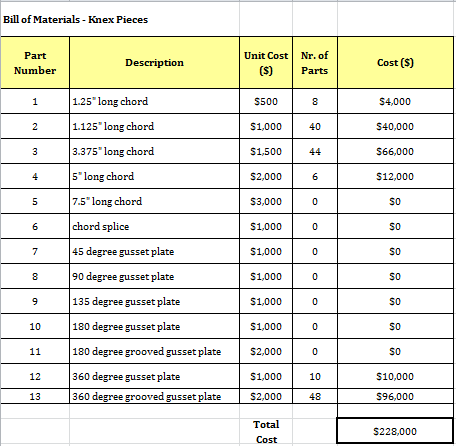
4. Truss Bill of Materials
5. The shape of the bridge was not changed much during the design, the hardest thing encountered was meeting the length requirement, many of the designs created were only 22" in length not the required 24". This led to problems when trying to find a design where the angles would work yet the length was sufficient. This design is certainly not the best work but without sitting in a lab and testing different designs there is no way take this bridge to the next level.
6. This assignment has shown that when working on designing something you need to have an image of what you want the design to look like going in so that you have something to work off of yet at the same time you need to keep an open mind in case problems arise. In this design problems arose that were unexpected such as trying to create a bridge that was long enough to span a 24" opening yet at the same time keeping in mind the fact that all connections must be made in increments of 45 degrees.
Showing posts with label Parker. Show all posts
Wednesday, April 25, 2012
Wednesday, April 18, 2012
Week 3: WPBD
Last week was spent working with West Point
Bridge Designer to come up with the cheapest design for a bridge that met the
constraints posted on the course website. This coming week we have agreed upon
refining designs and to being the initial planning stages foe the KNEX bridge
in the coming weeks. The biggest accomplishment that we had as a team was
seeing that the bridges that Arron, Dan and I Designed were first, second, and third
respectively in the class competition. I see no issues as an individual nor as
a team.
West Point Bridge Designer is intended for
Civil Engineers to get hands-on experience with bridge design. Real world
design problems have many possible solutions to the problem, West Point Bridge
Designer does not recognize all of the possible solutions as being correct.
West Point Bridge Designer is realistic in the sense that it will not allow a
bridge to span an opening that it cannot realistically span. West Point Bridge
Designer is also realistic in the sense that
it incorporates the idea of trade-off, meaning that when you change you
part of a design problems expectantly arise in a different part of the design.
Safety is one of the most important aspect of any design, you can create a
structure with the lowest cost to build but if you fail to design a structure
that can safely transport what it was designed to West Point Bridge Designer
will alert you to the problem. If this were applied to a real life design this
simple aspect of the program could conceivable save lives. I think that the
main majority of the aspects of West Point Bridge Designer are realistic but I
feel if they were 100% realistic that the program would be too complex to
understand and grasp, this leads me to believe that some aspects of the program
are not realistic. One major component that is not realistic is the vertical displacement,
this is exaggerated in West Point Bridge Designer to show that bridges do
deflect when carrying a load. West Point Bridge Designer does not take into account
horizontal forces such as wind either.
Subscribe to:
Posts (Atom)